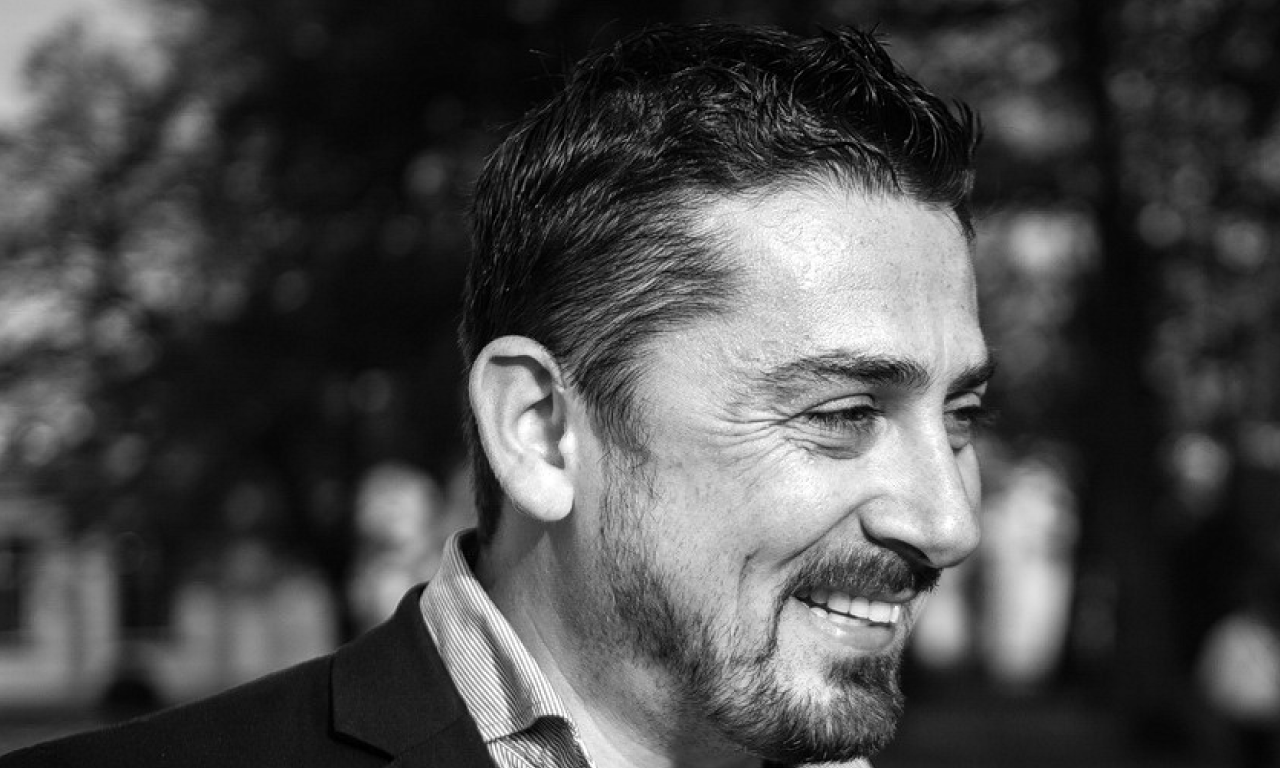
Passionate about everything product development involves, he has contributed, throughout his career, to the creation and launch of several web and mobile products. Dan Călinescu, a mentor with vast experience, is not only a co-founder of 3 new tech startups, but also the person who has been involved in every aspect of product development – from idea – to marketing, sales, design, development, launch, and management.
He spent 15 years in Toronto, Canada, but grew up in Bucharest and returned to the country, to Cluj, where he has lived since 2010 with his wife and their 4 children. Dan studied at the University of Toronto, where he successfully earned his Honours Bachelor of Science in Software Engineering. He's an advocate of open source and storytelling, but above all enthusiastic when it comes to education. At Informal School of IT Cluj-Napoca he is a discipline manager, Product Owner, and mentor within the Full Stack Product Development program.
The challenge is how you learn new things, grow, and advance in your career
1. What does the profile of the student the Full Stack Product Development program was created for look like?
The program was created for a new generation of Software Developers, a generation of original creators, who build their own products, not just work in outsourcing style. The ideal student comes either from the category of young people who are at the start of their career in Software Development, or from the category of those who have already worked in the field for many years but feel the need to grow in a new direction. In either case, the ideal student is a curious, energetic, and passionate person, interested in personal and professional growth.
Full Stack Development is an intense educational program full of intellectual challenges, so for him the challenge is how he learns new things, how he grows, and how he advances in his career. I'd also add that this program is meant to offer as real an experience as possible of what it means to build a digital product from idea to launch, which makes it especially suited to those who want to learn not just through theory, but through practice.
The products that changed the course of humanity are the ones built on a pragmatic dream
2. What's the starting point someone eager to develop an end-to-end product for the first time should keep in mind?
A key and very good question. I'd be glad if everyone who wants to develop an end-to-end product started from a pragmatic dream. If the idea of dreaming pragmatically sounds a bit strange, it's probably because we've become used to believing that having dreams is an idealistic and completely impractical way to live life. History shows us, however, that the products that changed the course of humanity are the ones built – not just on the resources or the context needed for success, but the products that succeeded were built on a pragmatic dream.
Only then can a person start building – line of code by line of code – that dream
I'd encourage people who want to develop a new product to first develop a pragmatic dream that becomes the basis, the direction, and the foundation of the whole story of the product. The exercise of developing this dream will bring to the forefront the motivation, expectations, desires, and passions of the person eager to develop a new product.
This way, the person can boldly move forward, namely start building brick by brick, or in our case, line of code by line of code, that dream, until one day, it becomes reality. That is, a product, which is nothing more than the tangible expression of that original dream.
The most natural way to evolve is the shift toward an industry that builds its own products
3. How necessary is it, right now, for someone with experience at outsourcing companies to have access to an educational offer based on training and coaching aimed at developing new software products?
Classic outsourcing business models — time-and-materials, fixed-price, staff augmentation, or other similar variants — are about to be radically transformed. The local IT industry will have to adapt one way or another, and the most natural way to evolve is toward an industry that builds its own products.
Programmers who work at an outsourcing company today will also have to adapt, if for no other reason than because the whole industry will transform. In other words, programmers will need to grow in the direction of Product Development and not just Project Development. To grow, they badly need an infusion of educational programs, preferably hands-on and intensive ones.
Full Stack Product Development offers exactly the kind of education absolutely necessary for a transformation of the local IT industry
In the context of industry changes, these programs will also evolve as a requirement, from optional, nice-to-have programs, to absolutely necessary ones, even an integral part of a company's growth strategy. Programmers and companies that invest in such a program today are investing in an excellent competitive advantage that can propel both companies and personal careers to the next level, in the right direction.
What attracted me to Informal School of IT is the fact that it represents that missing link in the local ecosystem, and any investment in this school is an investment in the common good of the community. That's why I decided to collaborate with Informal School of IT by developing the Full Stack Product Development educational program, which offers exactly the kind of education absolutely necessary for a transformation of the local IT industry.
Without mentors, it's almost impossible to enter a field as volatile and complex as the Software Development industry
4. How important is mentorship?
Mentorship is one of the essential gaps in the Romanian education system. Unfortunately, young people leave university with a lot of theory, but with little personal attention from mentors who could guide them in the right direction from the start of their careers, without them having to, so to speak, reinvent the wheel in their careers.
A mentor who has been through it all and knows how to accompany someone at the start of their journey knows how to guide individual growth and how to contribute to personal transformation. Without mentors, it's almost impossible to enter a field as volatile and complex as the Software Development industry. When it comes to developing outsourcing-type projects, it may be possible to advance without a mentor, but even there only up to a certain point. However, for developing an end-to-end product, I'd say the right mentor can make all the difference.
What will the training process look like?
Our goal is for every student to learn how to develop a product. End – to – end
Each student will join a team of about five people, with whom they'll work on developing a product. The goal isn't for every student to come up with product ideas, but rather to learn how to develop a product. The student will experience what it means to be part of a product startup, as a Founding Developer, that is, one of the first programmers who worked on that product.
Imagine what it would be like to collaborate with the first 3-4 people who developed a product we enjoy today: Facebook, Gmail, or Twitter
Imagine what it would be like to collaborate with the first 3-4 people who developed any product we enjoy today, whether Facebook, Gmail, Twitter, etc. Within this team, I'll mentor the student to find their Sweet Spot, that is, their unique place, where they can bring the most value to the team. Every student will go through the same material end-to-end, but some will have a natural inclination toward certain aspects of the product, such as the mobile side, while others will want to dig deeper into other parts, like the API side.
That's absolutely normal, and it also happens that way in the real world of startups, but at the same time, it's good for everyone to go through the entire material, so they understand every aspect of the end-to-end development process and thus develop a common language with their teammates.
You'll receive video lessons before the mentoring sessions
Besides the ongoing experience of working in a team, on the same product, the student will be personally mentored by me every week, during the mentoring sessions. Those sessions will be exclusively dedicated to the relationship between me and the students, where we'll be able to practice pair programming exercises directly on the project, or where I'll be able to offer practical advice to help solve technical problems, or simply to discuss certain topics in detail. At the same time, students will receive video lessons before the mentoring sessions, lessons that I'll prepare in advance and that can be gone through in their free time, as preparation for the mentoring sessions.
You'll go through as real an experience as possible of what it means to work at a product startup
In other words, we'll take an educational approach that completely flips the lecture/workshop paradigm. So the time spent in class will be workshop and mentoring time, hands-on, not a lecture. The lectures will be the homework, not the other way around. Students will also have access to a Product Owner dedicated to the product they'll be working on. This Product Owner comes with rich experience in Product Development and will give students as real an experience as possible of what it means to work at a product startup. And last but not least, besides all this time and know-how investment that each student will receive weekly, there will also be a weekly hour dedicated exclusively to students' questions, held online, like a webinar, open to all students.
KICK OFF A UNIQUE NEW LEARNING EXPERIENCE