Alina Ivan: "I'm 100% convinced that I could NOT have started working in programming without the Informal School of IT"
February 7, 2022
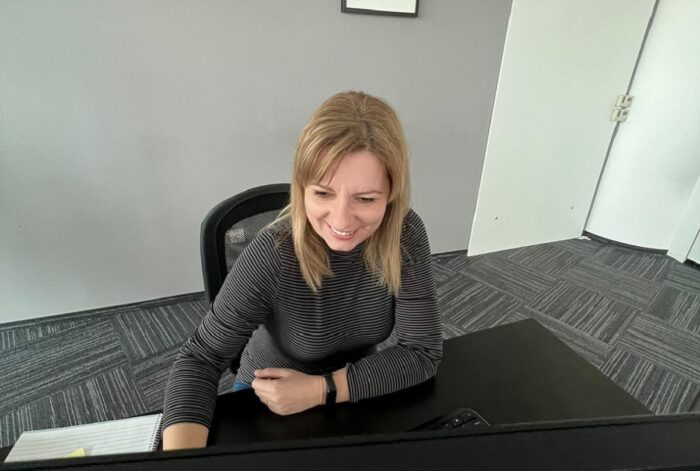
Do you ever think you wish you'd been someone else entirely, doing something completely different? For most of our graduates, the Informal School of IT becomes – through introspection – "the school of being yourself". Because there are people whom, through a set of circumstances, life has brought into roles they no longer recognize themselves in.
Just like Alina. After 16 years of experience in translation and 12 years working in banking, she enrolled in online career-change courses.
She tells us today: "The Informal School of IT changed not just my career, but my whole life". Her story? It could be yours too.
Alina, what were you doing before enrolling in the career-change courses?
I worked in banking. I worked 6 years in front-office, 6 years in back office. My main job, though, was as a translator. I graduated from the Faculty of Letters and I'm still an authorized translator. In other words, I have 16 years of translation behind me, plus 12 years of banking. When I decided to leave banking, it was, sort of, a convergence of circumstances… It seemed to me that things were moving heavily toward digital in banking, and I thought I'd like to be one of the people improving the processes and applications.
I don't know about others, but I was the kind of customer who only went to the bank when absolutely necessary. If I could do everything through Internet Banking, that was perfect. And there came a moment when I thought: what would it be like to be one of the people improving this story, digitalization? And that's when I started looking for career-change courses in IT.
You left the bank even though you had good career prospects there...
I could have stayed there. I could still be there now, it wouldn't have been a problem at all. It's just that I'd plateaued. The last 2-3 years in banking were extremely flat. I wanted a different challenge, and since I'd studied computer science in high school, I thought about IT and the possibility of taking career-change courses. As a teenager back then, I liked reading, and I focused on a university where I could learn foreign languages. Now, looking back, I realize that the way I learned foreign languages back then is the same way I later learned programming languages. It's pretty much the same thing.
20 years ago, something told me IT wasn't for me, I don't know what it was back then. In 2017, when I felt a very strong need for a career change, I reconsidered the situation and realized that, as they say, I wasn't really "off track". In the meantime, I'd studied on my own, watched online tutorials, done research, and then looked for career-change courses. So I said OK: it's time for IT career-change courses. I'm going down this road. It was the best decision.
I did a Google search and chose the Informal School of IT
Did you resign before taking the IT career-change courses?
I was employed at the bank when I enrolled at the Informal School of IT. Even though I had the basic knowledge in the field, I started with an Intro to IT career-change course, to refresh my knowledge.
I told myself: let's see what this course is about first, let me go convince myself. I liked the Intro to IT course and what happened at the Informal School of IT so much that I said OK, this is it. Later, after graduating, I resigned and got a job in IT.
What did you like about the Intro to IT course, and why?
I really liked the way the mentor taught the Intro to IT course. The material itself can be fairly standard content, but what matters is how the information is presented to you and how the mentor gets you to retain it.
My mentor was Adi Moldovan, and the energy he passed on to me during the IT career-change course helped me enormously. Of all the courses and trainings I've taken so far, I've only met that kind of energy and passion in one other person. For me, that's what matters in any kind of upskilling or reskilling course.
How did you find the Informal School of IT? Why did you NOT learn from the Internet?
I didn't learn on my own from the Internet, because sometimes I lack consistency. Long term, I would have ended up in situations where I'd say: "I don't have time today, maybe I'll get to studying tomorrow", because I needed a routine, someone to guide me, tasks to do. And I thought: "where should I even start?".
I did a Google search and chose the Informal School of IT. It seemed to me that Intro to IT at the Informal School of IT was the most structured career-change course on the market, after I read the curriculum. I saw it only lasted two months and said: "Let's try it! If I don't like it, I'll figure out what to do next". I don't regret the decision for a single moment.
I enrolled in October 2017, I started doing research on Google, and I think it was the last day I could take the admission tests. I remember it was 23:30 – 00:00, and the next day at 12:00 enrollment closed.
I even remember being nervous about the English test, even though I was an English translator, that's how much I wanted to study at the Informal School of IT. A week later I got the answer: I was accepted into Intro to IT, a career-change course I considered a good fit for me.
On weekends, while doing my homework, I was extremely energetic and happy
What came after the Intro to IT course?
Out of the many career-change courses, I chose Web Development (JavaScript). It was a natural step, because that's where my decision to change careers had started. I'd set out to improve how a user interacts with a website.
And because I need a lot of visual elements by nature, I avoided back-end programming. Given the choice, I chose what felt right to me, namely front-end programming. Good thing I did!
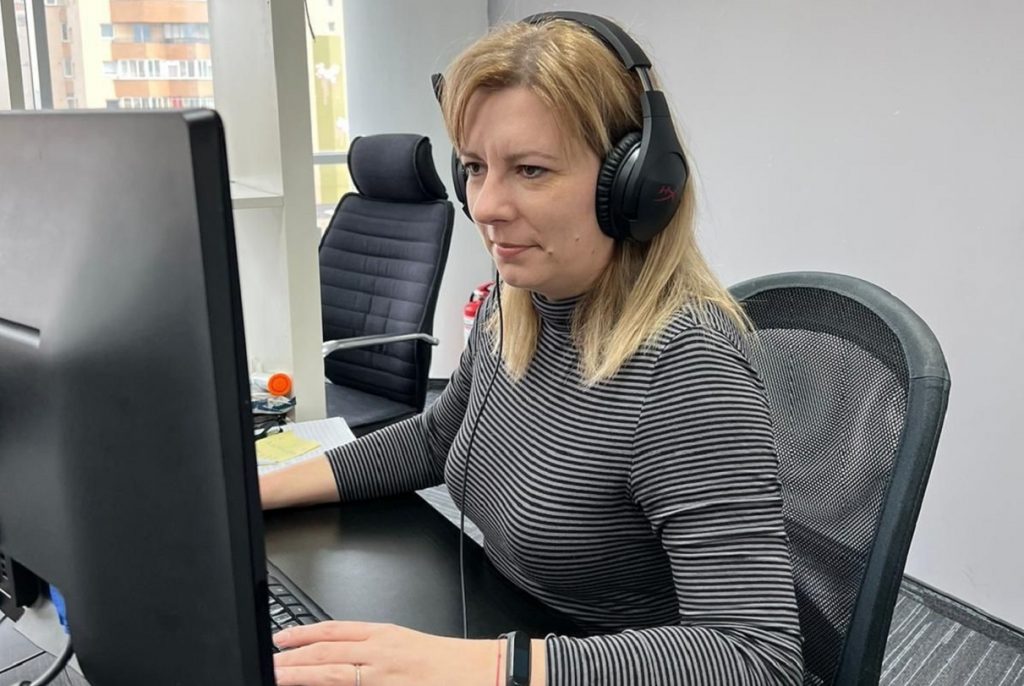
How was your experience in the programming course?
It was a pleasure to attend the course taught by Florin Nițu and Paul Negoescu, mentors at the Informal School of IT. Even though it was an extremely demanding and tiring period, it was really, really great. On weekends, while doing my homework, I was extremely energetic and happy, unlike during university when I was demoralized. The mentors had fantastic patience throughout the whole IT career-change course…
If in the Intro to IT course I "got a taste", so to speak, of what programming meant, in the Web Development (JavaScript) course, every new chapter felt like reading a new book. Extremely demanding, but very beautiful.
Taking an online career-change course was one of the best decisions I've made in my life.
Don't you regret choosing a paid course instead of a free tutorial?
Not only do I not regret it, I'm actually very glad. It's one of the best decisions I've made in my life. Taking an IT programming course was a good decision for me, aside from career and every other factor, including financial ones. Plus, everyone knows that, in the end, IT pays well.So you wouldn't put that in the "myths" category?
No, because it's a true, provable thing. A myth is that people who work in IT are zombies, weirdos, that they sit glued to a laptop 200 hours a day and don't move from in front of it. Heaven forbid! I'd tell anyone who believes that to go work at a translation company first. I'm speaking from my own professional experience, because translators literally sit at a desk and write. In banking, to give another example, there's a different situation: there's a lot of competition.
If I asked: "How did you do that?" Sometimes I'd be told: "I don't know, I don't remember." Well, I never found that in IT. It's the field with the highest level of collaboration. You have people to talk to, people to exchange ideas with! And I go back to the basic idea: if people say programmers are weird, let's not forget we're all weird in our own way. 🙂
I learned a lot from job interview experiences
After you graduated from the second course too, what came next?
I kept working at the bank until I found a job. I sent out CVs, asked for recommendations, went to interviews… I want to point out: job interviews can help you a lot to understand what the market wants, and can become learning resources. At one point I had an interview that lasted about 3h30. They needed someone experienced, but I ended up chatting with the person from the company, who showed me all kinds of resources: "Hey, have you heard of this website? Have you seen this project?". I found that really nice.
I looked for a job for a while, but now – looking back – I realize I really wanted to leave banking, and that I learned a lot from job interview experiences. I now have more than a year of experience in front-end web development, thanks to the online career-change courses.
What did graduating from the Informal School of IT change in your life?
The Informal School of IT, through its people, brought me more than I expected. I made very, very, very good friends. I didn't expect that. I met a lot of people through the relationships formed at the Informal School of IT, and a lot of success stories following graduation from the career-change courses. I couldn't have gotten to work in programming on my own, if I hadn't taken the online career-change courses at the Informal School of IT. I'm 100% convinced.
I wouldn't have made it alone. The Informal School of IT changed not just my career, but my whole life. Obviously, being a different environment, most aspects of my life changed one way or another.
The decision to enroll at the Informal School of IT can change your life
Is the Informal School of IT the right environment for people who want to learn IT from scratch?
Of course. I recommend all the upskilling and reskilling courses at the Informal School of IT! The decision to enroll at the Informal School of IT can change your life. Even within my own circle of acquaintances, in Brașov, there were at least two people who took career-change courses at the Informal School of IT, after I told them about my experience. The fact that, at the moment when you don't know where to start in a new field, you get guidance, resources, support, help, is something extraordinary.
People come here from absolutely every field of activity. Why? Because the mentors help you find out and organize all the information you need to make the career switch.
What message do you have for those who want to make the move into IT, but don't have the courage?
Trust yourself. Always. If you put in passion, it shows, it's felt, and you'll reach the result you want. There's something else just as important: don't choose IT just because it's trendy. Money is a powerful motivator, but it shouldn't be the only one. Don't do something if you don't like it. Because if you don't like it, frustrations will appear, no matter how much money you make. I once had a conversation with someone throwing around fabulous sums for juniors in IT, while I knew developers with 5-7 years of experience who weren't there yet. The beginning isn't easy. An entry-level job is paid like an entry-level job.
I left banking for a lower salary in IT. Because you have to follow your instinct, if what you're doing no longer fulfills you and no longer makes you feel like you belong there. I think the right approach is this: start thinking that in 5-10 years you want to earn more money, take IT courses, test whether the field suits you, and if not, find another option. This career switch can be made even after 35-40 years of age.
A lot of people told me I was crazy to leave banking, "you're the bank lady, you have a career there, a position. But it was a career that didn't fulfill me. When Monday came, I'd say: "God, it's Monday again, I have to go to work again…". I didn't leave because of the organization, my colleagues, or my manager. I left because I no longer recognized myself there: what I wanted to do was a bit more than what I was able to do there. Nowadays, working in IT, I find myself staying late without even realizing it. I've been working for more than 16 years, and that's happened to me very few times.
The career-change course at the Informal School of IT also helped me with this, to organize my ideas, feelings, what I like, how I like things to happen. But it all always starts from passion: did you like taking things apart, the way I liked taking apart my parents' alarm clocks as a child? Ask yourself if you have a real inclination toward this field.
I recommend to everyone, no matter what stage of their career they're at, not to hesitate to take upskilling courses for employees or reskilling courses for the unemployed. It will surely change their life!
Alina's story can become your story!
Enroll now!