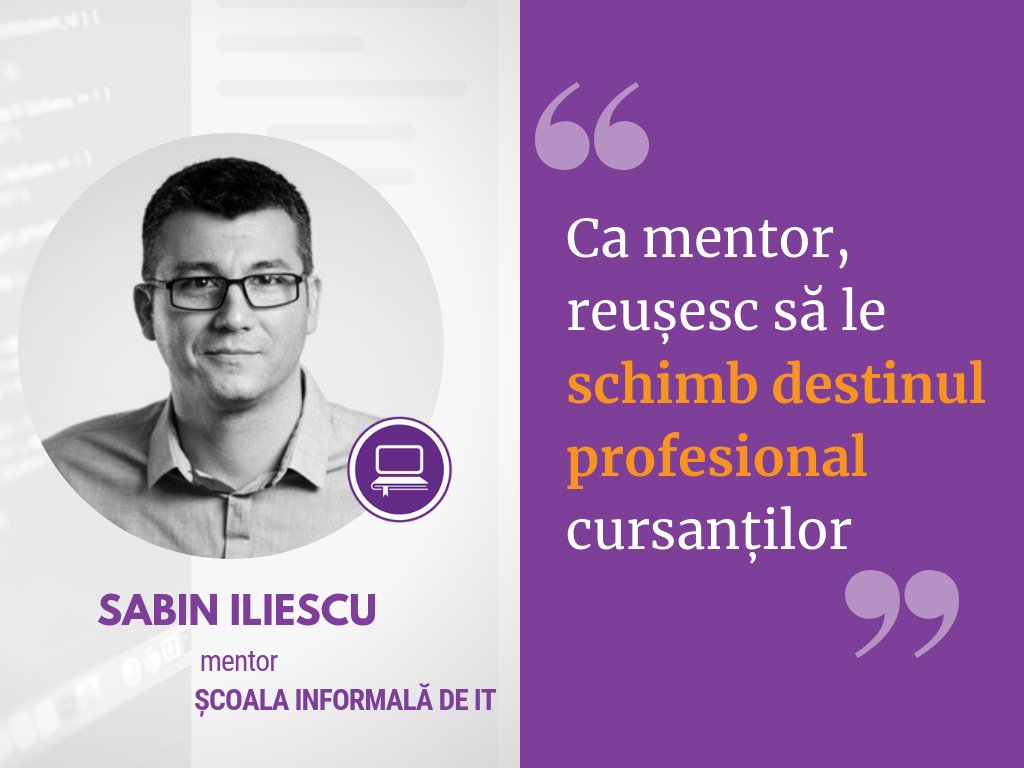
Sabin Iliescu is one of the longest-serving mentors at the Informal School of IT, with over eight years of experience in Web Development. As a specialist in his field, he has mentored, over time, in the Intro in IT and Front-end Development programs.
Sabin, have you always been a technical guy, or was there a shift in your career? What's the story of the mentor from ”Intro in IT”?
I can't say I was necessarily a technical guy, but I was always passionate about technology and sci-fi. I got a computer as a kid, back when it wasn't so trendy to have one.
In 2005, when I finished the Faculty of Automation, the IT industry hadn't really taken off in our country yet. On top of that, job opportunities in Craiova were limited. That's what led me not to follow my passion, but to join my family instead, to help grow a business.
After about 6 years, amid the economic crisis, I had to rethink my career path. Of course, the logical choice was to go back to what I'd been passionate about since childhood, but easier said than done.
Over all those years, I'd lost touch with technology, so I had to start learning again from scratch. It was a very tough period, having to absorb a lot of new, complex information in a short time. After several months of studying on an almost military-style schedule, I gathered the courage to go to an interview. I was lucky enough to get it, though not necessarily because of the knowledge I'd gained in the previous months, but rather because of the potential I showed.
While we're at it, I want to point out what an employer looks for in a junior programmer/tester. Besides a minimum of technical knowledge, they look at your potential and your determination to learn and succeed.
Well, from that moment on, my career path was paved with a lot of hard work and a desire to learn as much as possible. I always tried to stay on top of new concepts and technologies in programming.
I see that, besides your job and mentoring, you also find time to run ”Google Developers Group Craiova”.
Yes, together with a few fellow mentors at the Informal School of IT (Sergiu Boboc – FrontEnd mentor, Daniel Ianoși – PHP mentor, Irina Ștefan & Andreea Popescu – Testing mentors) and with the support of Carmen Ciulacu (Co-founder at GDG Romania), we decided to set up ”Google Developers Group Craiova”.
Through this collaboration, we want to popularize programming itself as much as possible. We also try to bring together as many programmers as we can, to give them, in an organized setting, the best possible exchange of knowledge and experience.
You can't do it without hard work, determination, and ambition.
Students need to understand that the harder it is now, the better it will be later.
What advice do you have for an outsider who doesn't know where to start getting into IT, but is determined to make the career change?
Most of the time, a career change is a hard choice and comes at a critical point in life. Hardly anyone chooses to change careers when everything's going well.
That's where the difficulty of staying focused on the course comes from: there's a lot of varied information. Every student needs a clear mind and concentration to manage to take in as much information as possible.
Throughout the course, I try to instill as much of my passion for IT as possible. At the same time, I try to lay solid foundations for an easier transition into programming or testing.
So, what would be the biggest challenges in an ”Intro in IT” course for an outsider, and what mindset should they start out with?
What needs to be clear to anyone who wants to get into this field is that you can't do it without hard work, determination, and ambition.
Although things seem simple at first glance, they get exponentially more complicated as you advance in the field. Toward the end of the first half of the course, most students lose motivation. They start wondering whether choosing to take this course was the right decision or not.
That's exactly the moment when they need to grit their teeth. It's good for them to think back to the original reasons that led them to enroll in this course. It's normal for it to be hard, given that this field is vast and complex.
Every student needs to understand that all of us went through this learning process. It wasn't easy for anyone at the start. In the end, students need to understand that the harder it is now, the better it will be later. Gathering as much information as possible in this field will let them make an informed choice about whether or not to continue down the path of programming or testing.
Why should our readers choose the Informal School of IT instead of going for the free tutorials that are all over the internet?
Tutorials are very good and have their own usefulness. Unfortunately, they can only take you so far. That's where my role as a mentor comes in. It's the nuances that help you truly understand the information you're given and help you retain it.
Without truly understanding what you're shown, it's impossible to reach top performance in this field. My role as a mentor is to guide students and filter out the right information from this whole multitude of sources, and explain it as clearly as possible for them.
How are the Informal School of IT's courses different from training in the traditional education system?
The school's mentors are experienced practitioners in the field. My approach to this course is practical, not theoretical. So I present the information during the course through as many hands-on examples as possible.
This way, the information given in context is easy to absorb. On top of that, the course dynamic becomes much more engaging than the classic way of delivering information.
Finally, Sabin, tell us why you chose to become a mentor at the Informal School of IT?
I like helping people, working with them. I personally experienced the importance of getting help, of getting feedback, at one point. At the Informal School of IT, I have the chance to pass on some of my passion for IT, and maybe, for some of them, even change their professional destiny.
APPLY TO THE INFORMAL SCHOOL OF IT