"Be ready to learn! I'll help you every step of the way". Interview with Alex Crăciun, mentor at the Intro to IT program
March 29, 2017
He's been working in IT for almost a decade, and his track record includes an impressive number of applications he's developed across a range of fields including ERP, Content Management, Networking, Online Bookings, Insurance, or Out of Home Advertising. Asked "What do you want to be when you grow up?", he would have answered, in turn: chef, pilot, or lawyer.
Today, Alexandru Crăciun is a specialist in .NET Development, Web Development, Agile Practices, and Consumer Hardware, having been involved throughout his career in many stages of a project's development. He's passionate about everything to do with programming, regardless of language. "You think is a game?" has become his motto, because he treats every new challenge with seriousness, pragmatism, and professionalism.
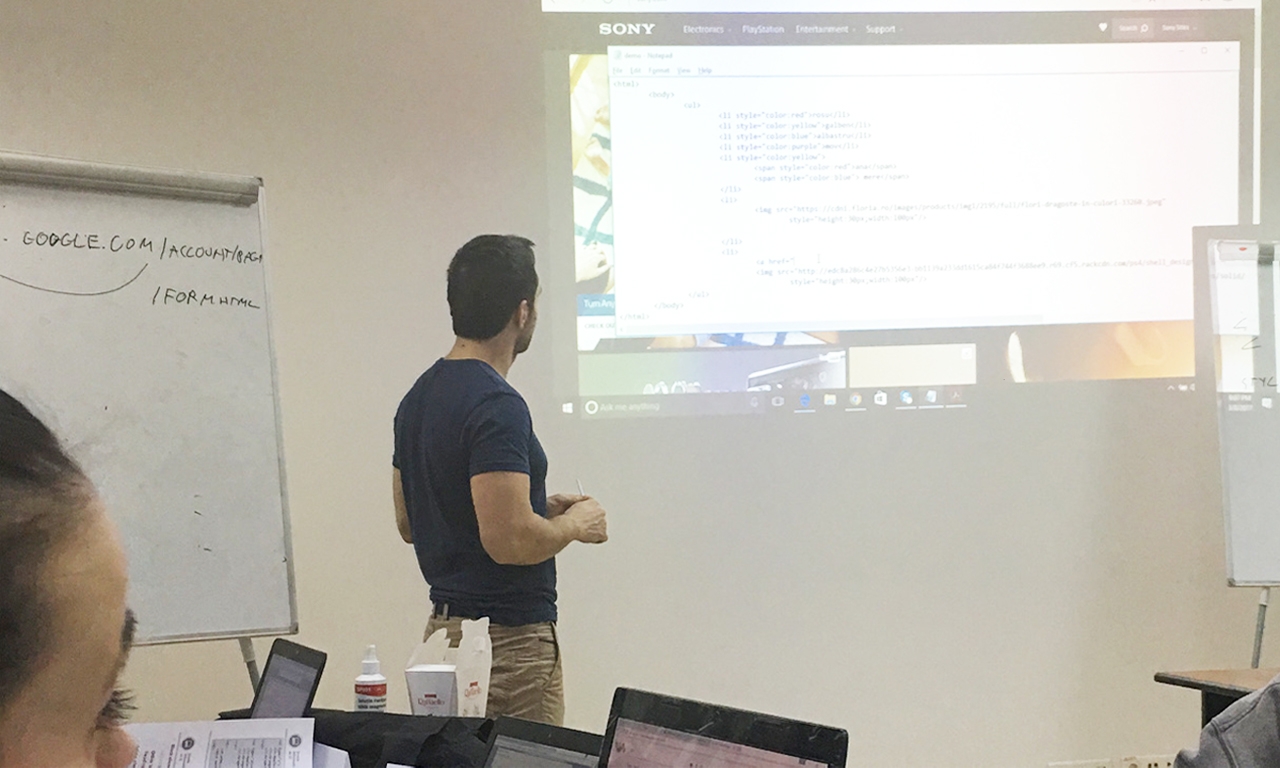
Alex is a mentor at the Informal School of IT. In the Intro to IT educational program, he'll guide, at every step, those who want to prepare for a career in this industry, even if they've had no contact with IT so far.
"Be ready to learn!" he wishes everyone who wants to grasp the basics of IT at the Informal School of IT Bucharest.
Let's get to know him better!
Alex reaches a decade of experience in IT 1. Where did the desire for a career in IT come from? I always liked computers. Games are what first drew me to computers. Then curiosity pushed me toward the hardware side, and I tried to steer myself toward distribution. At the start, I chose the software side, and little by little I started to like programming. I started part-time at a small company where I did my "apprenticeship" back in my second year of university and… the rest is history.2. If you hadn't been in IT, you would have had a career in…
Law. Before becoming a programmer, I wanted to study law. I liked movies and TV shows about lawyers. I knew a few basic objections, which I'd seen in movies, and a bit about conduct in American law.
3. With almost a decade of experience in IT, what can you tell us about challenges and satisfactions?
There were challenges at every step. Both because of the different circumstances in which the applications were developed, and because of the experience (or lack of it) at the time. There have always been satisfactions too, from implementing a simple process when a user clicks a button, to properly implementing a load balancing scheme on an application and solving performance issues. The challenges, although the most numerous were technical in nature, the biggest ones were always related to working with other people: understanding others' expectations, as well as calibrating my own.
4. How have things changed in the industry from the start of your career until today?
It's a bit hard to separate the changes in the industry from the process through which I came to understand it better and better myself. On the technology side, the adoption of some technologies and the abandonment of others has accelerated a lot. As much as the need for a programmer to learn something new and forget some of the old. But, by far, I think most of the changes are on the management side.
If 10 years ago it was standard to have tasks in Excel, to practice micro-management, and to track hours, now the trend is toward a "collaboration" approach regardless of role or seniority. People have understood that it's better in the long run to put a task in someone's hands and tell them you trust their ability to solve it, rather than closely supervising them. Positive motivation is superior to negative motivation, and soft skills have started to gain more importance, sometimes even over hard skills.
Starting out in IT: practice, lots of practice
5. If you were to write a recipe for a successful career change, what would the ingredients be?
Fail fast and learn. Don't be afraid of criticism, enjoy it, because it gives you material to reflect on your own abilities. Don't look for the ideal project, but rather the ideal team. Leave enough time for yourself too, to do some sport as well. I can't tell you how many colleagues are in physical therapy for back pain.
6. How important is being self-taught?
The traditional education system, at least the one I went through, is clunky and outdated. The most valuable thing I taught myself was how to quickly learn something that seems abstract at first glance. Being self-taught will take you further than any education system, and it's something you need to develop, because a programmer who doesn't have it doesn't stay a programmer for long.
Or ends up working on very outdated languages and systems, with people and mindsets to match.
7. What's different at the Informal School of IT?
It's practice, lots of practice. In the Intro to IT educational program, I'll draw analogies from every field to help students who've had no contact with the IT world understand the concepts and information being taught. I've gotten very good feedback for this technique.
8. What should the profile of a developer just starting out look like?
Someone with skills and a desire to learn, with a positive attitude and an open mind, who takes responsibility and pride in their work, but who also has a bit of humility. As the years go by, I become more and more convinced that soft skills are a bit more important than hard skills. It's much easier to teach someone a new programming language than to change their attitude.
9. I'm a student at the Informal School of IT. For 6 weeks, you'll become my mentor.
What can you tell me right now about this experience I'm about to go through?
Be ready to learn! The world has changed, it's constantly changing, and IT (more than any other industry) keeps up and even sets the pace, so you'll have to change too. To do that, you need to learn. I'll be by your side and I'll help you every step of the way, but you need to understand that in this field you need to learn things often and always look to improve yourself.
You won't come out at a loss, I guarantee it. Nowadays, almost everything around us contains some form of software or another (TV, bluetooth speakers, even traffic lights) so you need to understand this concept. Thinking in abstract terms will help you grow in other fields too, and you'll start to look at the world with different eyes. So… I'm looking forward to seeing you at the Intro to IT educational program.
What others don't know about you:
1. Do you have a nickname?
I haven't had one in a long time. The last one I got was in the USA, and it was Sparky.
2. Asked "What do you want to be when you grow up?", what would young Alexandru have answered, and why?
First, a chef: I liked food and I still do. Then a pilot: my parents worked at an airplane repair company, I thought that was cool. Then a lawyer: because of movies and TV shows about lawyers.
3. When did you get your first computer and what model was it? And your first phone?
I got my first computer around 5th grade. An AMD K6 233 MHz, 64mb ram, Riva Tnt, Quantum Fireball HDD, CD-rom, speakers, Genius keyboard and mouse, CRT monitor.
First phone: Alcatel OT 320.
4. What other hobbies do you have?
Fitness and nutrition. But I'm also passionate about new gadgets, music, and hi-fi equipment.
Want to be mentored, step by step, by IT professionals? YOU DECIDE WHERE YOU START