<<"Where do you see yourself in 5 years?" isn't a cliché, it's motivation to start now>> Interview with Melania Moldovan, Front-end Development mentor
November 22, 2017
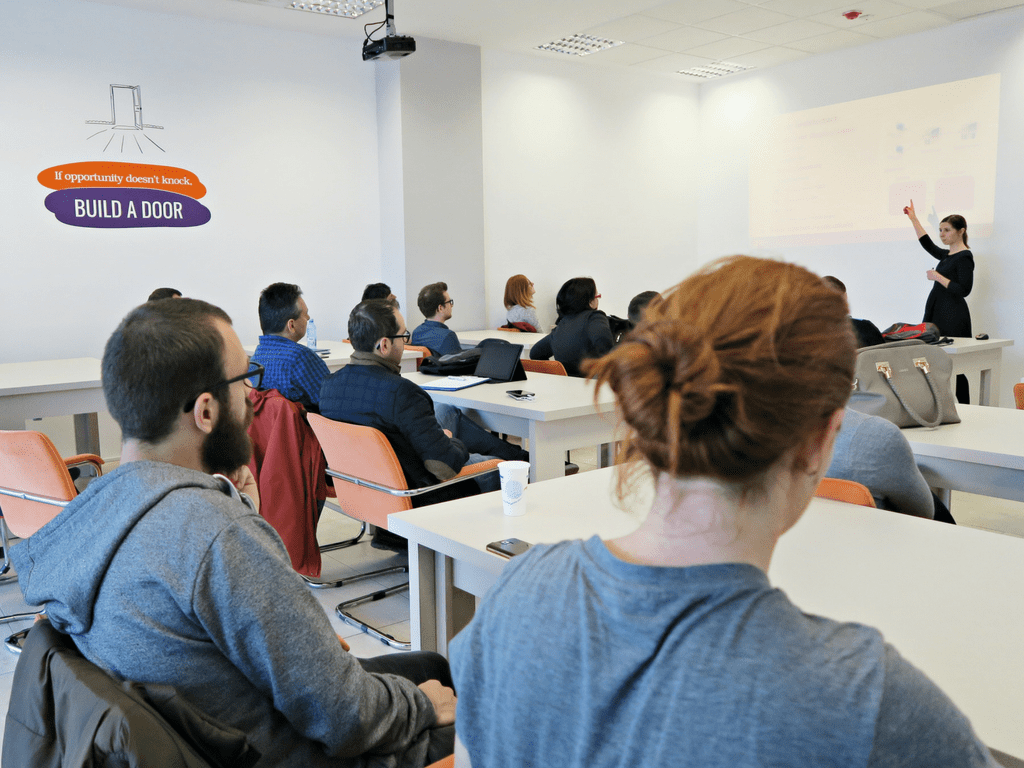
She touched a computer for the first time in 3rd grade, and two years later she had one of her own. Back then, she didn't know the job of programmer existed, so she wanted to become a math teacher. Today, Melania Moldovan has a career on the rise in IT, while she also successfully practices her passion for teaching. People know her as "Mela", because meeting her carries the mark of friendship. She has an immense talent for passing on what she knows, through a warm presence, the knowledge and experience gathered over her career. Melania Moldovan is a mentor on the Front-end Web Development program, where she infects students with the desire to follow their passion for technology. She believes "Where do you see yourself in 5 years?" isn't a cliché, but the motivation to prepare for a career in IT, starting right now.
If you're passionate and interested, it's not that hard to find a job in IT
1. Where did the desire for a career in IT come from?
Since high school I really liked math, and I wanted to work in an industry where I could use this passion. Computer science seemed like a fairly close field at the time; I had a few older friends who were already students and who encouraged me to go in this direction. The Romanian education system also mattered a lot, since I wanted to be financially independent once I finished my studies.
2. What can you tell us about the challenges and rewards of a career in IT?
The most important thing is that I still get both, to this day. Fortunately! The challenges have to do with the constant advance of the technical field (it's often said that it's hard to keep up with technology, sometimes it feels like you're always chasing it), and with communication, interacting with clients and colleagues. But that's also where the rewards come from: the fact that people thank me and appreciate me professionally means a lot to me.
3. How have things changed in the industry, from the start of your career as a programmer until today?
I started working in IT more than 7 years ago, and I was lucky enough to like it a lot. Back then, career changes into IT were fairly rare; more people were heading in a different direction, away from IT. Things have generally changed for the better: demand is higher, and if you're passionate and interested, it's not that hard to find a job in the field.
It's encouraging to know that others go through the same situations you go through too. It helps to know it's possible.
4. What didn't you learn in school, but wish you had?
I graduated from the Faculty of Automation and Computer Science, Computer Science section (English track). I learned a great deal, the most important thing being that I learned how to learn and how to manage with little data. But, unfortunately, I didn't learn many of the basic programming concepts, either because they weren't in the curriculum at all, or because we weren't taught how important they are and why. I wish university had focused more on the fundamentals, and less on the complicated formulas I don't even remember anymore.
5. If you had to write a recipe for a successful career change, what would the ingredients be?
You need passion, perseverance and patience. We all have moments when we're more or less motivated, and that's normal too. What matters is that the motivation comes from a passion for technology, not from financial need. Patience is very important, because opportunities in the market don't always show up exactly when we want them to. You have to make the most of the quieter periods, to learn and deepen your knowledge as much as possible.
6. There are many, diverse learning resources available online today, many even free. Why is mentorship important?
The main problem with online learning resources is that there are so many of them. As a beginner, you don't know which ones to choose. Mentorship is very useful, because it creates a setting where information isn't just handed over, but your questions are answered and you get personalized recommendations. Last but not least, the motivational and social side is very important: it's encouraging to know that others go through the same states and situations you go through too. It helps to know it's possible.
I encourage students not to become "user manuals", but to understand every concept they learn and apply it in practice
7. What does "mentorship" mean when we talk about Informal School of IT?
In short, at Informal School of IT, mentorship means adapting an already validated curriculum and learning structure to the needs of each student. We manage to do this through the feedback we give in a personalized way during course sessions and when we check homework. But just as important is creating a space that builds trust, where everyone just starting out is always encouraged to ask questions and collaborate. So far, I've happily noticed the work ethic of the students, the passion and ambition of those who, for a while, have a job in another field and/or kids at home.
8. In your view, what's the profile of a developer just starting out?
Passion for technology is very important, and just as important are very solidly consolidated basic skills. I always encourage students not to become "user manuals", but to understand every concept they learn, to write code to deepen their understanding of it, and to ask for feedback on what they implement. Attitude matters too. Success also comes down to how adaptable each person is and how much they manage to pass on what they know to others.
9. I'm a student at Informal School of IT. For 5 months, you'll be my mentor. What can you tell me right now about this experience I'm about to go through?
From the very start, it's clear that it will take a lot of work. Besides the 5 hours a week of actual course time, you need to go through the resources provided and do your homework. I encourage you to collaborate with all your classmates and to ask me for help without hesitation, whenever you feel you need it. You should know there will be tough moments too, but the ones where you'll be thrilled about what you've learned or built will be more numerous, and they'll be what stays with you.
Where do you see yourself in 5 years?
Choose to be part of the next generation of Front-end Web Developers!
LEARN FROM PROFESSIONALS PASSIONATE ABOUT IT