What does it mean for a pharmacist to become a programmer? Xenia Petrea, Informal School of IT graduate, talks about passion
March 12, 2019
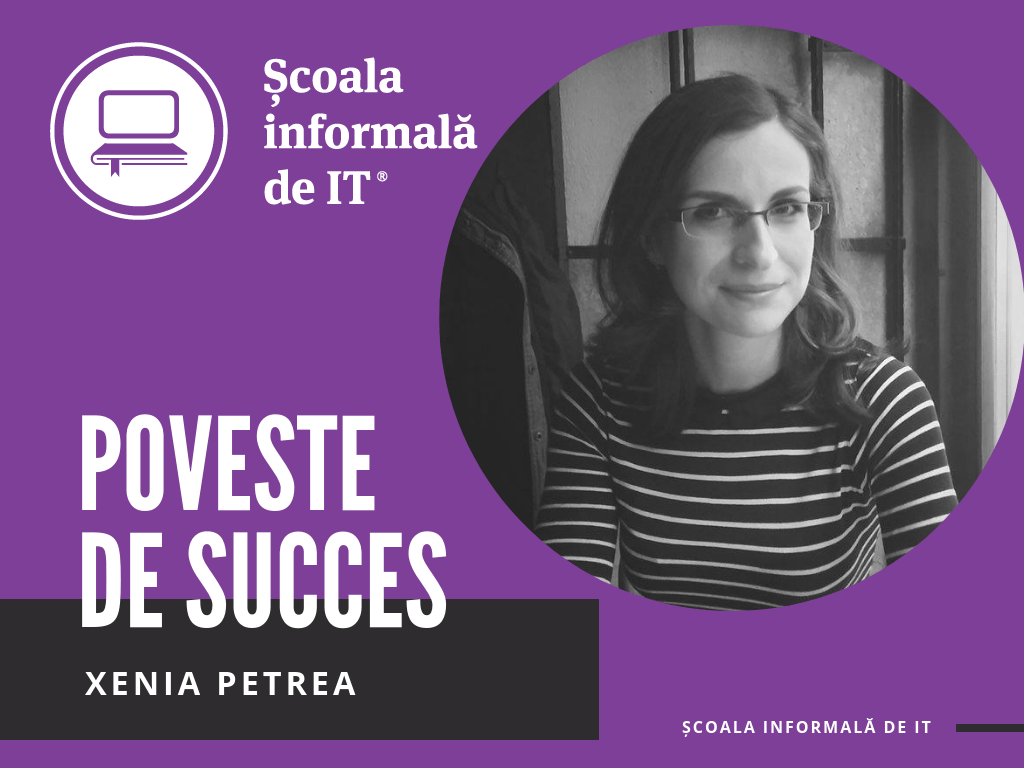
There are people for whom the words "per aspera ad astra!" tell a life story, as naturally as anything. For Xenia, it's not just a motto learned by rote in Latin class, but a principle that has guided her entire professional path, out of passion. She wanted to be an architect as a child. She became a pharmacist. But her recipe for fulfillment, it turns out, was written in IT. Because at 29, Xenia Petrea set her mind to taking her passion for abstract and concrete further. She tells us there came a moment in her life when she asked herself just four questions:
Can I see myself growing old in my current job, or even in the same industry?
Will what I'm doing now still be useful in 10–20 years?
Am I willing to devote a large part of my free time to studying?
Am I ready to push through obstacles, or will I give up at the first setback?
The answers brought her to the Informal School of IT, where she got the basics of the field and later learned JAVA. One of the most popular programming languages — ambition, perseverance and passion gave her the chance to find her calling. In IT. Today, "I feel like I belong to a dynamic team, one that lets me keep growing all the time," Xenia tells us, about what every day looks like for her now at work.
What does it mean for a pharmacist to become a programmer?
Xenia tells us.
1. Why IT?
I'm a pharmacist by profession, a beautiful job, but one where things have changed a lot lately. At some point, I felt like I no longer recognized myself in what I was doing. That I was plateauing. I wanted a change. I believed then, just as I do today, that IT is a dynamic field, where you can never get bored, an industry that offers more and more opportunities. I had an idea of what to expect, because in high school I'd followed a Math-Computer Science track. That's how I decided to turn my passion for computer science into a new career.
2. Why the Informal School of IT?
A good friend of mine, a programmer, suggested that IT would be a field that suits me. That confirmed my wish to take my passion further. So I decided to make the switch, but I first set my mind on building a solid foundation. I started searching online for the options I had to begin learning. I discovered the Informal School of IT and everything felt motivating right from the start: the live interaction with mentors, the hands-on courses held twice a week in the afternoon, the homework for studying at home, the team projects. It was something tangible, compared to any kind of tutorial or online course. That's how I decided to enroll in Intro in IT. That was the course that gave me the chance to first experience the basic concepts.
3. How did the experience from the Intro in IT course concretely help you?
In the first two months in this field, new to most students and to me too, the Intro in IT mentors, Florin Nițu and Bristena Ene, were a great support. I gained the basic knowledge of the field, while getting insight into the challenges that awaited us later, in everyday life on the job.
That was thanks to them, the mentors. Following the course, I also knew which of the educational training programs would suit, going forward, each person's way of thinking and problem-solving style.
You have the support of people from the IT industry, with enough patience and experience
It's an ongoing process. When you're just starting out, there are so many new concepts that you might end up feeling overwhelmed. But that's where the mentors' role comes in. That's exactly why you have the support of industry people, with enough patience and experience: to explain the concepts to you, whenever needed, adapting to your level of preparation.
Later, by actually working and reading, you'll make more and more connections. The terms that seemed so abstract a month ago will become part of your everyday language today.
5. How did you realize you wanted to become a programmer, and not a software tester, for example?
The training sessions on algorithms in the Intro in IT course were my favorites: I found them interesting, challenging. That's when I realized I'd like to continue in the back-end area. My organized way of thinking was an asset for continuing in this direction. After finishing the Intro in IT course, I went to the course held by my future mentors, Dănuț Chindriș and Anca Damian, and their enthusiasm convinced me. I chose to go on learning JAVA, one of the most used programming languages today.
6. Tell us about a moment from the courses that you remember in particular.
There are many moments. The ones where, after hours and hours of work, the program compiles, where you have a spark of insight and suddenly the problem you were trying to solve is no longer a problem.
There are those feelings of fulfillment when things start falling into place, after hours or entire days when you felt like you were going in circles looking for a solution.
Today I feel like I belong to a dynamic team, one that lets me keep growing all the time
7. From pharmacy to IT: how was the job interview?
As a test of all the knowledge gathered at the Informal School of IT, that's how the job interview was, in a context where I was challenged to make logical connections that would show I'd understood and could apply everything I'd learned in the 5 months of training.
After graduating from the Java Development course, I took a break of a few months, during which I let the concepts I'd gathered settle and did extra reading.
You can never say you're ready for the first technical interview of your life.
I had set out with different expectations. It was only at the Informal School of IT that I understood what a programmer actually does. It's a much more demanding and much broader field than I thought, but full of possibilities depending on the skills you have. The Informal School of IT taught me to be patient with myself.
Yes, when you're just starting out, the program will never work on the first try, without errors. What matters, though, is being able to learn from that, to enjoy discovering how to fix an error, and to be confident that next time you'll write more efficient code.
You can learn IT at the Informal School of IT in Bucharest, Cluj, Iași, Timișoara, Brașov and Craiova.
The fact that the mentors work in the industry was a big plus
From the mentors at the Informal School of IT I received a lot of encouragement and support in the moments when I felt stuck or like things weren't moving as fast as I wanted.
And, of course, answers to all the questions, no matter how simple/silly I considered them at the time. Java is a very broad programming language, and it's very hard to teach the basics to beginners, to explain abstract concepts through practical, relevant examples.
The fact that the mentors at the Informal School of IT work in the industry was a big plus. In practice, they explained the theory to us using examples relevant to real-world applications.
9. What brings you fulfillment, today, in your day-to-day job?
I have something new to learn every day. I interact with people with a lot of industry experience, both in Java and in other areas (such as SQL or QA), whom I can consult.
I feel like I belong to a dynamic team, one that lets me keep growing all the time.
10. A closing thought, for whoever is reading this interview.
Persevere! Even if it seems hard at first, it's just a challenge. The satisfaction when you succeed will be all the greater.
The best advice someone gave me when I was just starting out was "Trust yourself more!". That's what I pass on to the reader too.