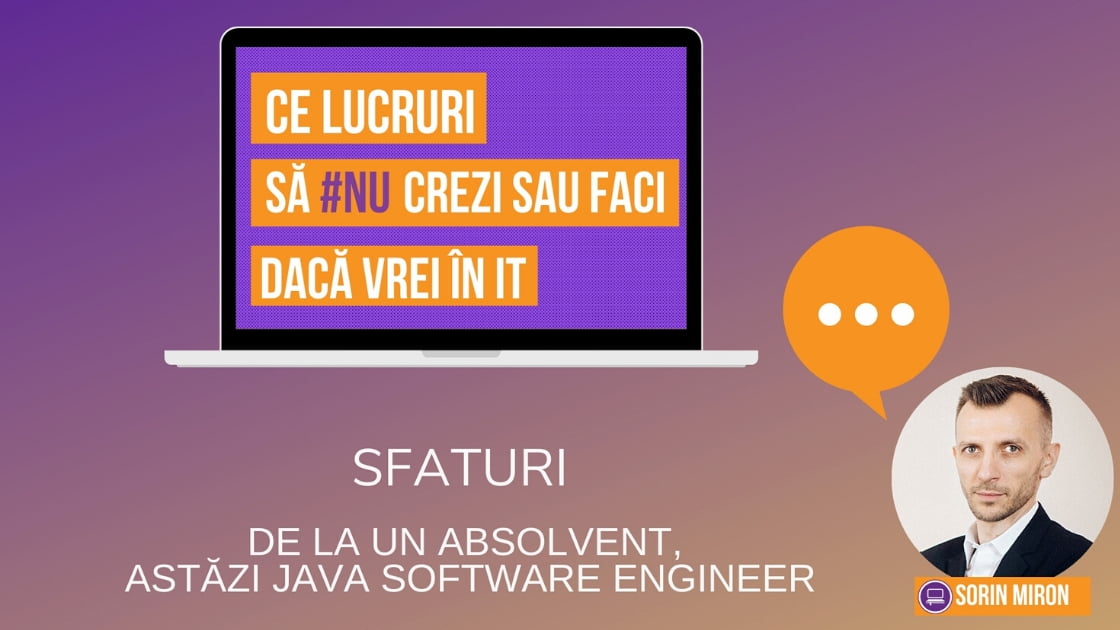
“Last year, in March, I finished the Java Development course at the Informal School of IT. Around the same time, I went to interviews and got hired at SoftVision. I'm currently a Java Software Engineer (Junior 2) and I have a message for current and future students”.
Signed, Sorin Miron.
That's how this article came about, confirming once again that the Informal School of IT is where people with one superpower meet: the power to inspire. Sorin removes the comma between job interviews and success — someone who doesn't nail textbook principles into place, but calls things by their name after living through the experience of his life: a career change. “He told me, smiling, that the interview went fine. <<I think you have everything you need to work with us as a Java programmer>>. I won't forget what I felt when I got that answer”. And that's how his story begins.
Here's what people say about hiring programmers in IT that isn't true
✓ You can't get hired / change your professional field at just any age.
Well, I changed fields at 41. Also, in Web, we have a colleague around the same age as me, who was also a former manager.
✓ Nobody hires you as a junior programmer if you held a higher position in the past.
I was CEO of a company, with a salary triple what I had when I got hired as a junior programmer. It didn't matter, not to me, and not to the company that hired me.
✓ Nobody hires you as a programmer if you don't have experience.
This is a mindset specific to employers from 2000-2005. When I finished my computer science degree, I wanted to get hired as a Java programmer and, even though I had theoretical experience and my bachelor's thesis project to show for it, I wasn't hired. They said I didn't have experience. Now, almost 20 years after finishing college, and with the only recent Java experience gained from the Java courses I took a few months before getting hired, I got the job.
✓ You can only work as a programmer if you have an IT education.
Honestly, I think you can come from other fields too, but you'll have to work much harder at the start. For software testing, web design, project management, even for front-end or other IT roles, it's a bit simpler and the learning curve is steeper. But to excel as a back-end or DevOps programmer, you need to develop a specific way of thinking.
The newest courses at the Informal School of IT:
Agentic AI with .NET – Artificial Intelligence Course
Power BI for Analysts: Modeling, DAX & Dashboards Course
Here are the biggest 10 mistakes made by people who want to get hired in IT and don't succeed
- I'm not ready for the interview yet. I'll study a bit more and show up for the next one.
- I don't know if I have the necessary knowledge, what if I make a fool of myself at the interview?!
- I'm already too old for this field. Who's going to hire me now?!
- If my colleague X went to the interview and wasn't accepted, what's the point of me going when I don't know as much as they do?!
- I don't need a LinkedIn account. It's just Facebook. Nobody from HR looks at it anyway.
- I'm going to an IT interview, it doesn't matter how I look or that I show up in flip-flops.
- I won't put my previous experience in sales / management on my CV. It'll just get in the way.
- I wasn't hired because I'm …. I'm not going to any more interviews.
- I agreed to go with one company, but if others reach out too, I'll say YES to them as well and choose later.
- I took the courses, I graduated, but I don't apply to jobs, I wait for them to come find me.
Tips & Tricks: what (not) to do if you're about to show up for an IT job interview
1. Don't go by prejudice and don't make the mistakes above. 🙂
2. Make sure you arrive at the interview location a quarter of an hour early.
You never know when you won't find a parking spot, which is what happened to me. I had to park 200-300 meters from the office and come running so I wouldn't be late. Not funny!
3. Keep applying to jobs in the field you want to work in.
Follow on LinkedIn the companies you'd like to work for: see who you know there. Ask for information about the company, the hiring process, the work environment. Find out if it's the right place for you.
4. Don't give up.
It's a good idea to go to interviews, even if you don't pass them. From any experience like this, you'll learn things that will help you pass the interview at the company that's right for you.
6. Don't take a job just to have a job.
At first you have this idea: it's good to get hired, no matter where you land. Everyone tells themselves “I'll get in anywhere and then move on later if I don't like it”. But if you don't fit with the working style of the people at that company, it's better to keep going to other interviews until you find something that fits you. It's important, both for you and for the employer. Everyone is spared a lot of hassle and wasted time.
7. If you weren't accepted at a company, you shouldn't fall apart psychologically.
Maybe it has nothing to do with what you know. Maybe it doesn't even have anything to do with you. If you didn't pass an interview, it doesn't mean you're weak, it means you weren't a fit for the project that company was hiring for. I spent a year on an internal project (where, I admit, I learned a lot of useful things and technologies that very few people in the company know) and only after that did a client project come up that matched my profile, where I joined as a junior Java programmer. A year. But the people there knew how to treat me and how to keep motivating me to keep advancing.
And now, a final thought:
“God doesn't always give you what you want, but gives you what you need. The moment you're ready and you know deep down that you've done everything to get something, you will get that thing, without fail”.