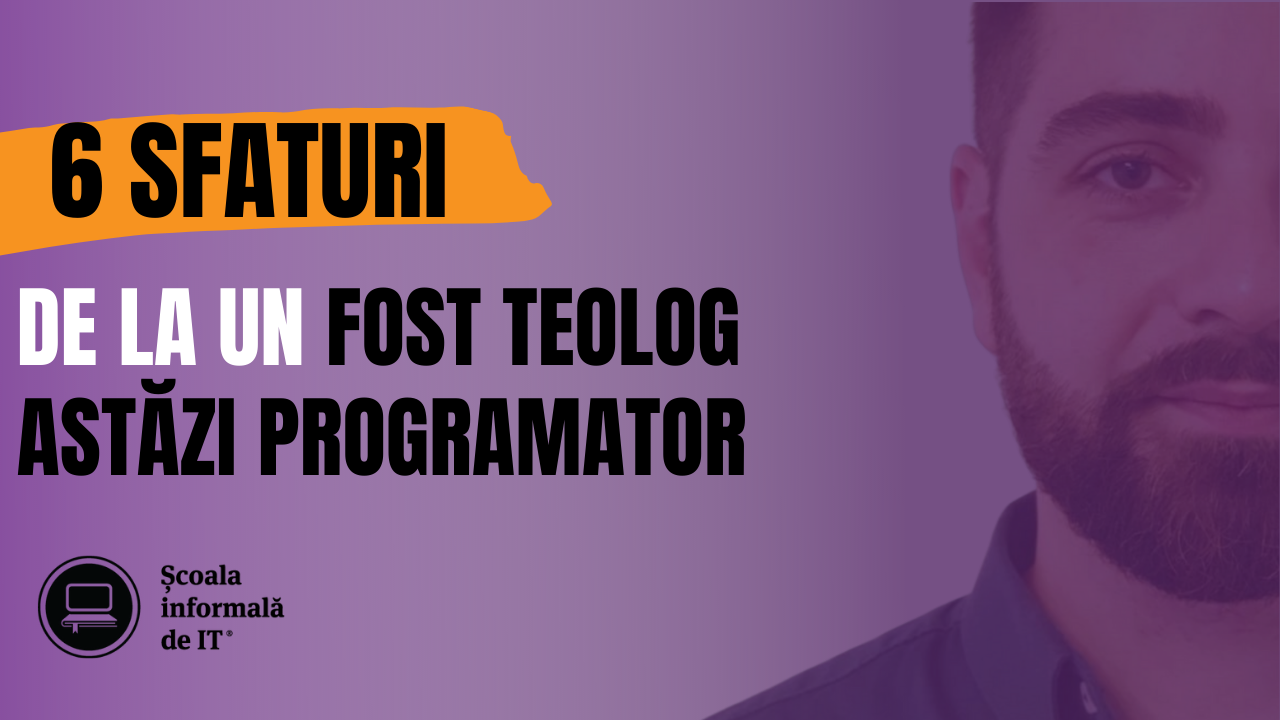
“I ended up doing what I wanted, what I love. I designed this desire myself, I pictured myself in the future doing programming. But it's simply human nature to fear new things.”
Ianis is a man who has experienced sweeping changes throughout his life. And literally so, as well as figuratively! He studied theology, but he also graduated from the Web Development – JavaScript course. He felt a calling to the priesthood, but he listened to his heart when it urged him to learn IT. He went through the Informal School of IT as a student, but today he is a mentor. He experienced change, and today he teaches others to embrace it too.
He's one of the people best suited to answer the question ”How do I become a programmer?” or, more precisely, ”What do I need to do before simply enrolling in a career-change course?”.
6 tips for you
1. If at some point you had a dream and believed in it, try to follow it, even when you just want to find out whether a career change is worth it or not.
Do everything possible to fulfill your dream of becoming a programmer, or just to convince yourself that it's what you want, or… not. I ended up doing what I wanted, what I love, but I designed this desire, I pictured it, I saw myself in the future doing programming.
I set out on this path with this conviction. Try it too — it's the only way you'll find out whether it's worth it: you can start with Intro to IT, a course specially designed for beginners, where I can mentor you too.
Personally, I found fulfillment and a sense of belonging in programming, after I convinced myself that the priesthood wasn't what I wanted. Since I started working in this industry, I've become a different person. Even though I'm an extension of the person I was before, IT has brought contact with open-minded people into my life and with a healthy culture, plus a more relaxed routine compared to before.
At the same time, this career change created a balance between my professional life and my personal life, and that's what I value most: being able to draw a clear, fine line between my job responsibilities and my personal life. See how important this aspect is for you too, and keep in mind the advantages of working in IT, when you picture your future: imagine what it will be like to work in programming, before you ask yourself “how do I become a programmer?”.
2. Think ahead. Before enrolling in a career-change course, do your research, get familiar with the terminology, and brush up on your English.
My advice is to think about the future as concretely as possible. Look inward and see whether you actually want to create programs and applications, and if the answer is “yes,” start reading right away.
You need to read enough to form a general idea of the field and become familiar with the technology, so you can conclude: “yes, this is what I love”, “yes, this is something I identify with”, “yes, I want to know how to become a programmer”.
Brush up on your English. The language barrier matters a great deal, because all the materials you'll find will be written in English. It's very hard to find quality materials in Romanian.
3. Once you actually start studying, don't expect it to be easy. It's hard, but be patient: you'll have plenty of “AHA” moments along the way, believe me.
As you run into concepts, you'll understand them better. If you only truly understand a concept the second, third, or fifth time you encounter it, that's not a problem at all.
You'll have that “AHA” moment — “now I get where this comes from.” You need to be patient and, very importantly, you need to focus on the basics. You have to thoroughly learn the fundamentals of the technology you want to work with.
Later on, in the programming career-change course, everything will be built on this foundation: language syntax, general computer programming concepts, algorithms, and data structures. You need to know these very well, because everything else is built on them.
4. Surround yourself with people you know support you, not with those who will discourage you. It's very easy to get discouraged, and not out of ill will — it's simply human nature to fear new things, like moving into a field you had no idea about before.
In my case, the idea of a career change and choosing a job in IT came both from my own conviction and from the encouragement of family and friends. I had support all around me, from a small circle of close friends and from my family.
I kept the decision to take IT career-change courses mostly to myself, which is why I say “a small circle of friends” — I didn't want to tell everyone openly. I chose not to say it, precisely out of fear of being discouraged.
It's very easy to get discouraged, and not necessarily out of ill will. Maybe it's simply human nature to fear new things, or things that look so drastic, like switching to a career you had no idea about before.
5. Find your real motivation for making a career change. Salary alone isn't reason enough.
I do what I love, and I'm well paid for it. Most of my fellow professionals can certainly say they're well paid too. But that's always what comes afterward. If you don't work with passion, you won't find fulfillment in this field.
Most people who don't have real passion for IT never manage to land a job in the industry. Or if they do land one, they won't grow there, and frustrations will eventually surface — which, in my view, isn't good at all.
It's very important to be convinced and to realize that the financial part comes after a successful journey — after the journey in which you enjoyed the experience of learning and of developing as a future programmer.
Understand that if salary alone is what pushes you to take IT career-change courses, it's harder. Only after you feel you have a place in IT can you consider the financial side — and at that point, simply enjoy it.